This webpage article is an enhanced version (with images and links to more information).
The text-only version of the handout is available as a PDF document download that you can print without using too much ink.
A fine example of kidney iron ore can be found on a window sill in this church and Vernon’s Bradley’s excellent 1997 history of the church is called “Built By Men Of Steel”. Let’s find out why!
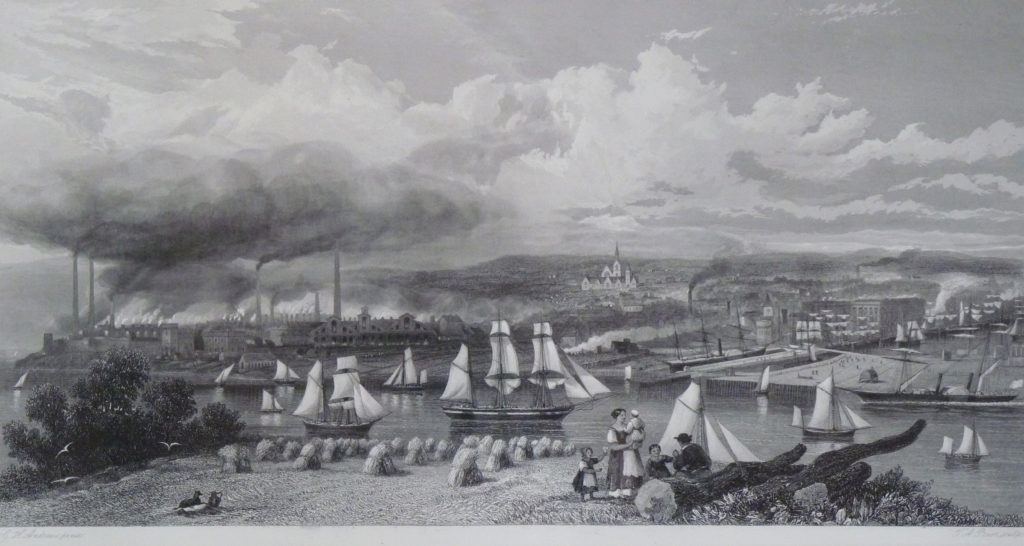
In 1846 the Furness Railway was opened, with 24-year old James Ramsden as Locomotive Superintendent, the first locomotives arriving at Rabbit Hill, Salthouse, by sea. The railway was funded by industrialists, notably William Cavendish, 7th Duke of Devonshire, to carry the rich haematite iron ore from the Dalton area to the deep-water berth at Piel Pier on Roa Island.
Larger iron ore deposits were soon discovered by the chief speculator Henry Schneider and, in 1857, as the Ulverston and Lancaster Railway connected Furness to the national network, Cavendish had acquired land at Hindpool for the building of the Schneider, Hannay and Company ironworks. In 1861, his investment in new railways from Durham also enabled the transport of coal here for steel production, James Ramsden becoming managing director of the renamed Barrow Hematite Steel Company three years later.
The Parish Church of St. George’s, consecrated in 1861, was located near the original railway station at the Salthouse end of the Strand. However the new iron and steel works, which with 10 Blast Furnaces and 18 Bessemer Converters would become the largest in the world, saw an influx of workers from rural Furness and across Britain to Hindpool, new tenements and terraces springing up rapidly. Barrow’s population would increase from a few hundred people to tens of thousands within 25 years.
The Parish Church of St. James, sited on top of the hill overlooking the works and houses, was funded by the now-profitable steelworks, William Cavendish gifting the land. Architects Edward Paley and Herbert Austin designed an impressive structure of local brick with blue brick patterning and ashlar sandstone dressings. It is 128 feet long by 60 feet wide by 75 feet high, the 150-foot spire surmounted by a cockerel weathervane, Inside the then-1,000-capacity building, there is the architectural rarity- for that time- of brick arches on St. Bees sandstone pillars, the church having perfect proportions and superb acoustics.
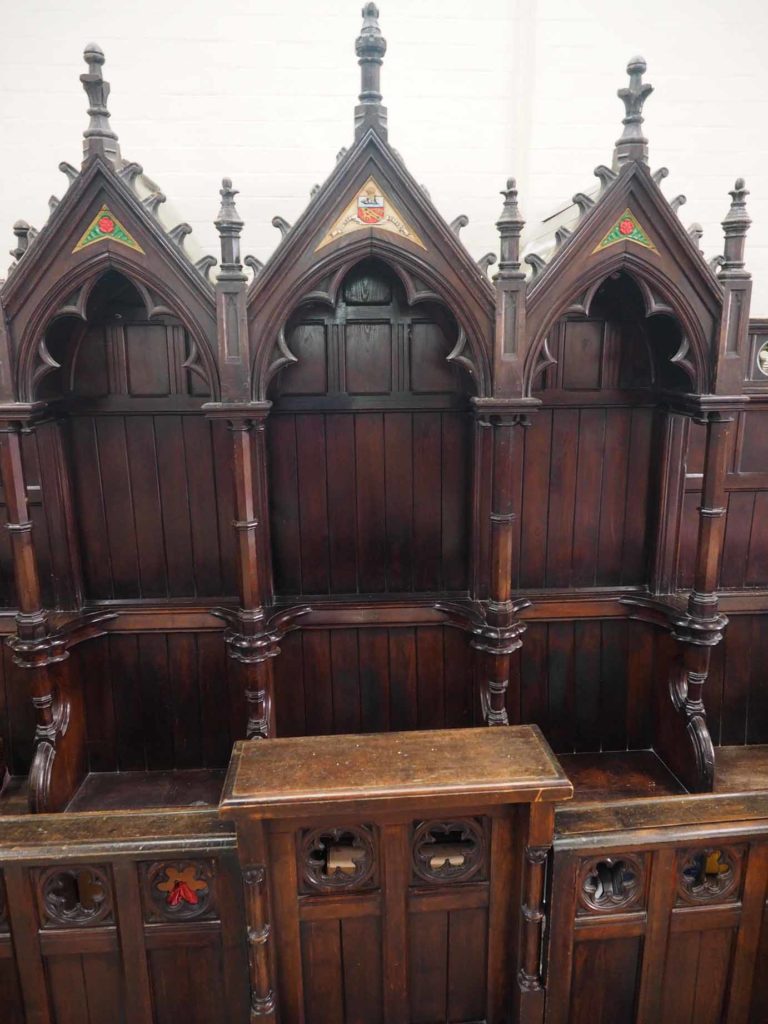
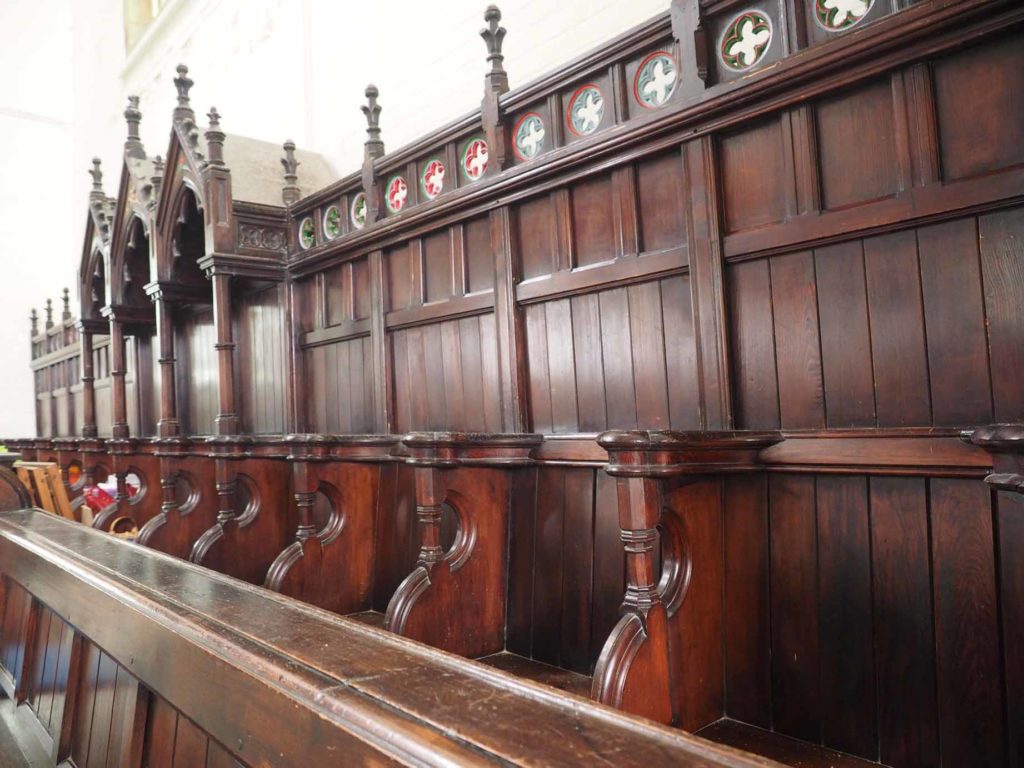
Barrow had now replaced Dalton as the main town in Furness, and James Ramsden was appointed the first Mayor of the County Borough. St James was consecrated on Whit Sunday 1869 and Mr. Ramsden, to be knighted in 1872, sat in the mayoral seats still under the West Window.
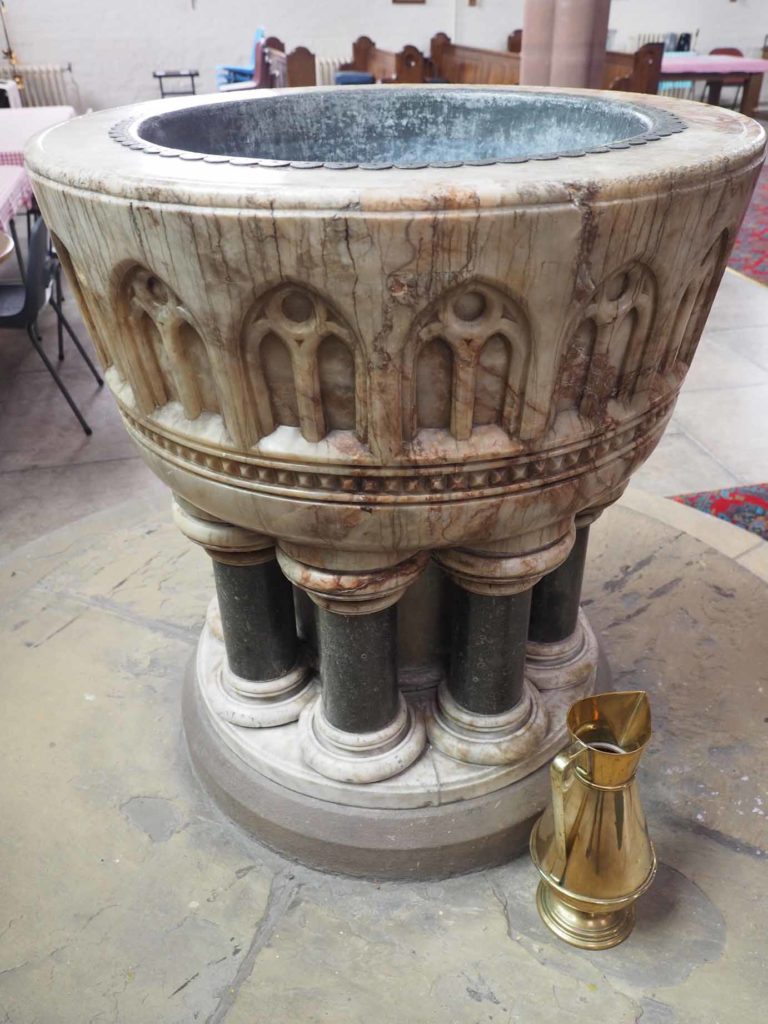
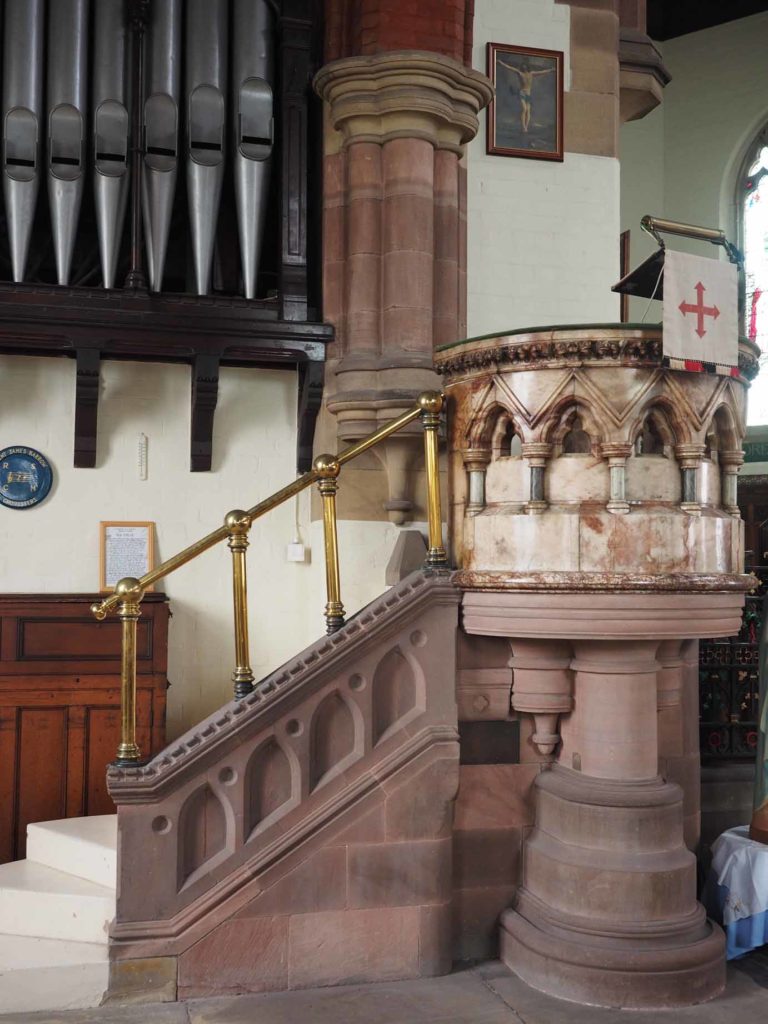
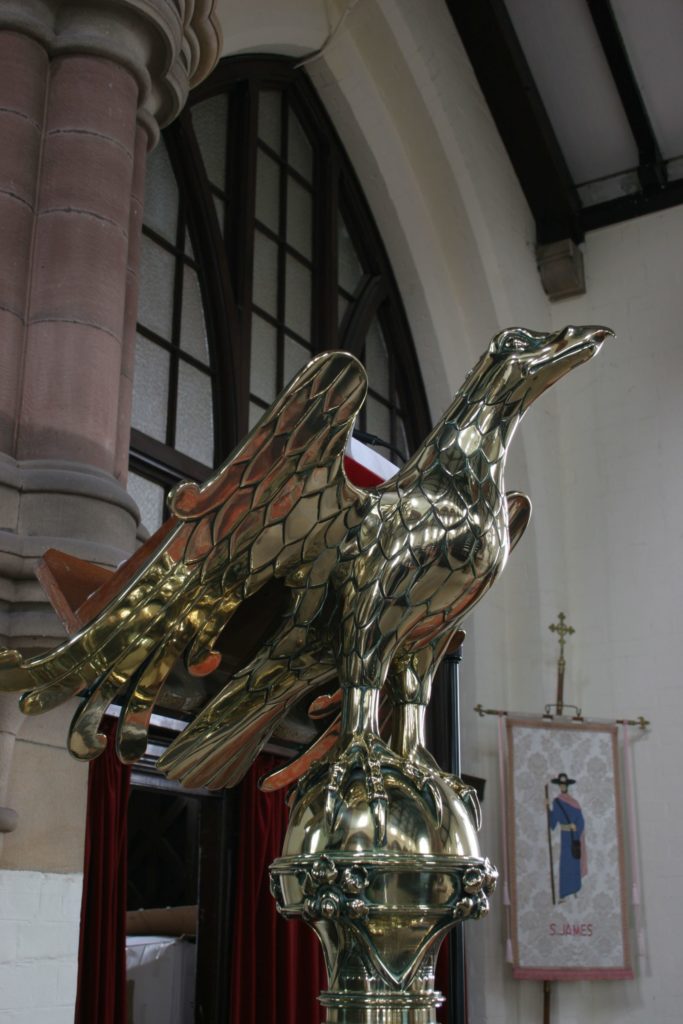
The Derbyshire Alabaster and Italian Marble Font, which matches the Pulpit, now stands in front of the mayoral seats, but was originally in the Baptistry. The Eagle Lectern, with base of local red sandstone and dais of Derbyshire Alabaster, was donated by Ramsden’s wife Hannah and 10-year-old son Frederic. The Sanctuary floor and steps are of black and white marble. Emulsion paint now covers the original interior walls of grey/beige brickwork with Victorian dado inlaid with blue brick.
A peal of 8 bells in an oak frame was designed and installed by Thomas Mallaby of Masham in 1877, being cast by John Warner & Sons in London. These were re-hung in 1902 and again in 1924 for the new bearings. Please see the separate Bellringing page and history of the bells leaflet (StJamesBells-leaflet.pdf) for more details!
Tragedy would strike William Cavendish twice with a serious fire requiring rebuilding of his country home Holker Hall in 1871 and his son Frederick, Chief Secretary for Ireland, being murdered in Phoenix Park, Dublin, in 1882.
A memorial plaque to Frederick can be seen in the north aisle as well as a memorial window (sadly destroyed in the blitz) presented to the Church by managers and men of the steelworks.
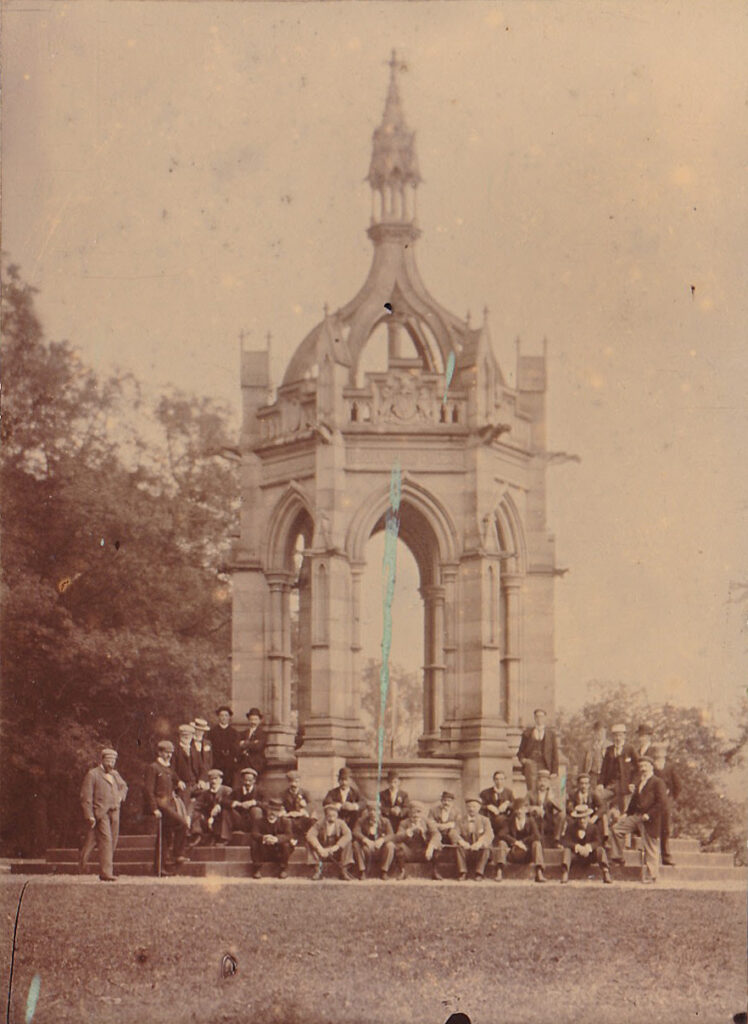
A memorial fountain to Frederick was built in Bolton Abbey in 1886 and the church visited this memorial afterwards (see photo).
In 1941, St. James was badly damaged by a German land mine and closed for two years. As well as much of the roof being lost, the organ was damaged and, in the church tower, a floor crashed down on to the bells. A witness account by Jim Burles (bell tower captain at the time) from across the Walney channel is recorded in the tower log book and transcribed in the tower website history page.
15 of the original stained-glass windows were destroyed including the West Window, these being replaced by lattice type leaded windows. The Sanctuary windows were fitted with temporary wartime glass of yellow hue until replaced in 1954 by the present trio of windows depicting nativity, crucifixion and resurrection; at the same time two new stained-glass windows were added in the Baptistry.
The current stained glass in the West Window came from St John’s, Windermere after its closure in 1995, and was fitted in the restoration here five years later.
One window did survive however, the First World War Memorial window, dedicated 1922, in the Chapel of Remembrance, where you can also find pictures of the bomb-damaged Church. Also in the Chapel is the Book of Remembrance donated to commemorate the 75th anniversary of the founding of the British Legion. An oil painting of Madonna and Child brough from France by a British soldier is on display; this was also brought from St. John’s, Windermere along with the altar, Bishop’s chair and lectern.
Photographs of the wartime damage and fragments of the original stained glass windows can be seen on the History of St James the Great page, and photographs of the stained glass windows mentioned above are included on the The Church Building page.
In the Chancel, we see the historic organ, built by William Hill in 1837 for the Chapel Royal of St. James Palace, London, where Queen Victoria and Prince Albert married in 1840. In 1868 the organ was moved from there to St. James and re-built in 1884 with new action and 400 additional pipes. The organ was again restored 1948 after war damage and was dedicated to him. For more information and photographs see The Organ webpage.
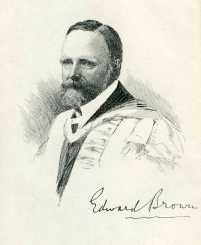
The photo on the pulpit side of organ shows Edward Brown, Doctor of Music, who was organist and choirmaster from 1871-1930. The church has had a proud choral tradition which continues today.
More information is provided on The Choir webpage.
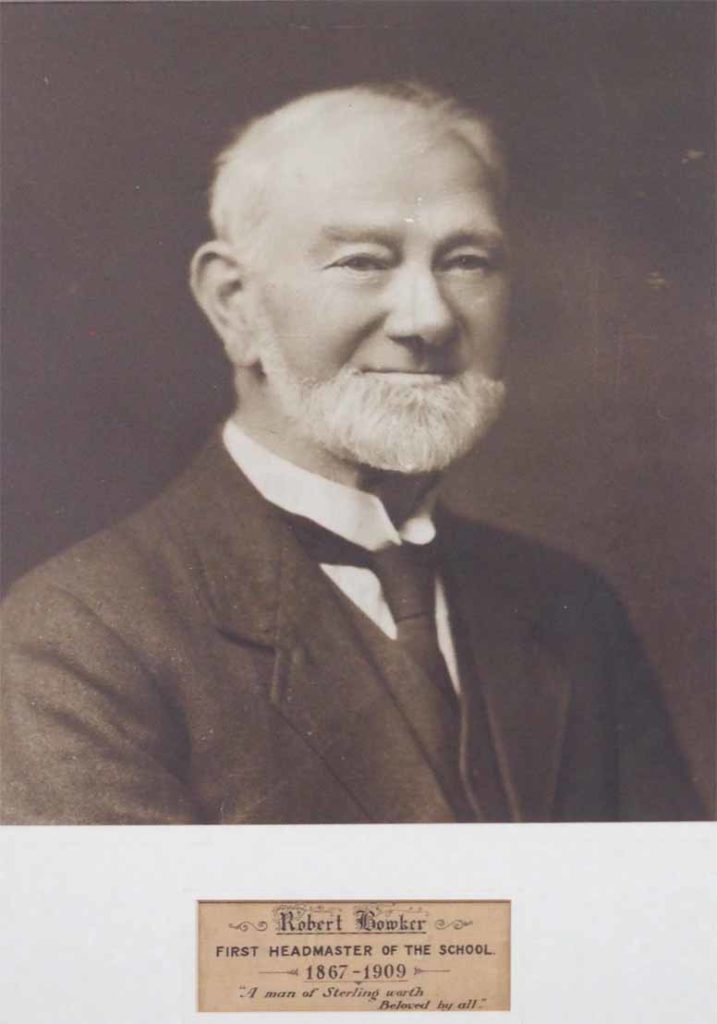
The photo on the altar side of the organ shows Robert (Boss) Bowker, first headmaster at St. James School from 1867-1909.
In the Sanctuary is the Carved Reredos and High Altar Table of English Oak dating from 1919. It stands as a memorial to the men of St. James who gave their lives in the First World War, their names being carved on the side panels.
Since the repair of the serious blitz damage, the Church has seen further work to gain and protect its now Grade 2* listed status. In the 1970s it was cleaned of years of industrial grime through sandblasting.
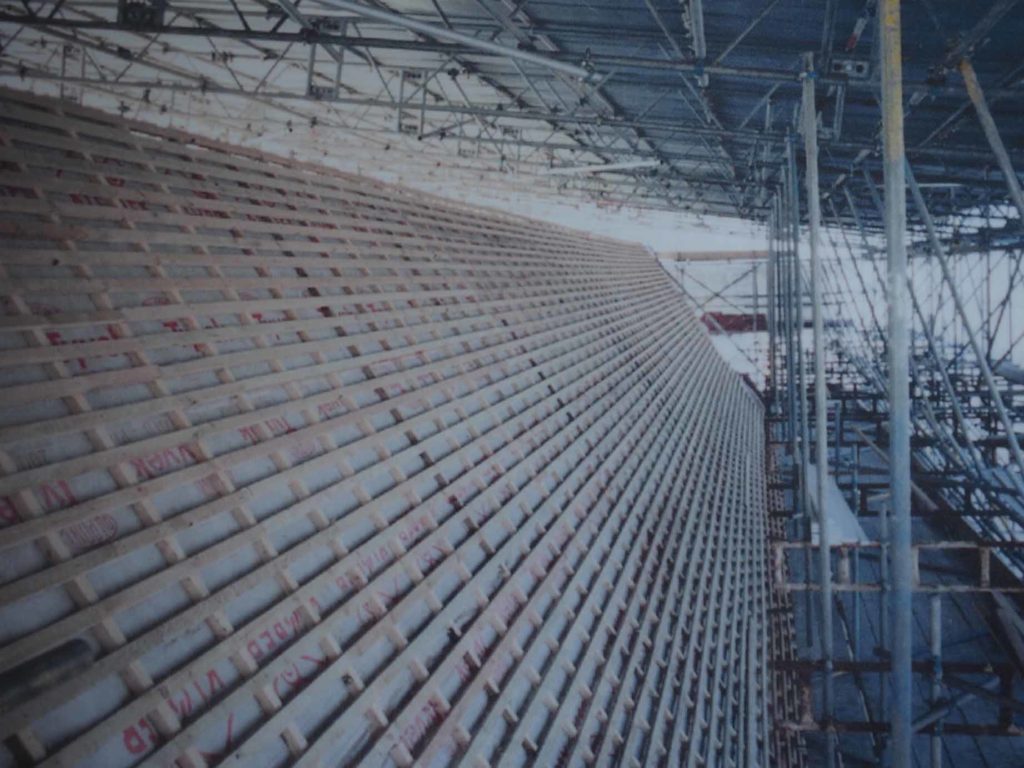
In 1999 the church closed for three years to enable a massive restoration project, re-roofing while replacing the West Window and stone tracery. Windows and louvres in the tower were restored.
£1 million was raised from superb support through the local community and charitable trusts, with the lion’s share of the funding coming from a successful grant application to the Heritage Lottery Fund.


The church bells stopped ringing earlier in 1999 before the church restoration work began because the bells were in a very poor state of repair, and this was confirmed after the church restoration completed when the peal of eight bells were inspected and were deemed to be unsafe to ring. 10 years after the bells fell silent, a plan to repair the bells in situ, evolved into a full restoration project taking 5 years to complete and over £150,000 of further support from community, grant bodies and especially the National Heritage Lottery Fund. The original 1877 bells are now retuned, and installed lower in the tower below the old belfry in a brand-new bell frame, with new floors, a viewing gallery and hand rail up the spiral staircase, live video stream in church, and hourly daytime chimes.
An extensive photo-gallery of the bell restoration project is available on the tower website.
The credence / collection table at the back of church was crafted by the grandson of Jack Bagnall (tower captain and ringer 1933-1997), from the original oak bell frame.
Even Alfred Wainwright has sketched the church, the Ven. Colin Stannard, then Vicar of St. James commissioning one for the Parish Magazine in 1955 which AW provided free of charge- as long as six subscribers could be found for his forthcoming book, the first of the now-famous Pictorial Guides to the Lakeland Fells! … See the Alfred Wainwright webpage.
More details about the above Church history and service to the community, including many more photographs, can be found on the Church website https://northbarrowchurches.org.uk. There are also many other items of interest in the church, details of which can be found in Vernon Bradley’s church history.